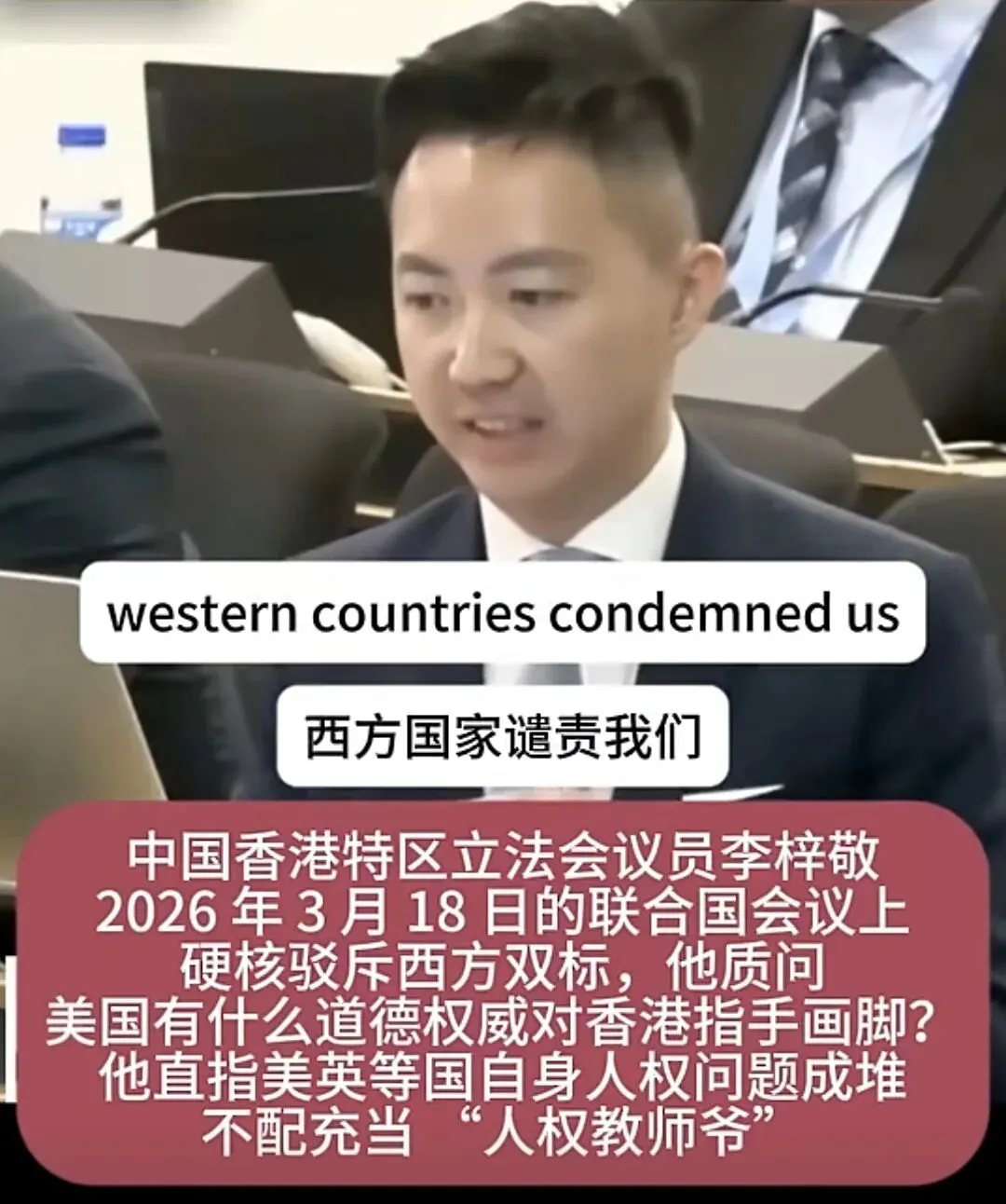
中国香港立法会议员李梓敬在联合国人权理事会第61届会议发言
Mr. President,
When the Hong Kong National Security Law was enacted in 2020, Western countries criticized us and imposed sanctions, claiming that this law violates human rights. But I want to say: since its implementation, Hong Kong’s economy has recovered, tourism is booming, and our people have regained a sense of security.
More importantly, what moral authority does the United States have? A country captured by figures like Epstein—what right does it have to point fingers at my country, a nation that has lifted over 800 million people out of poverty?
What moral authority does a country like the United Kingdom have, which arrested more than 12,000 of its own citizens merely for posting online, yet dares to lecture us on civil liberties?
And what moral authority do those NATO countries have, who preach human rights in this very chamber but turn a blind eye to the genocide in Gaza—who are they to tell us what justice is?
We will never be silenced by countries that treat human rights as bargaining chips or tools of foreign policy. These governments use human rights as a weapon, yet their hands are stained with the blood of Palestinians and Iranians. They choose to forget.
We will not rest until every country in this chamber is held to the same standard. Until hypocrisy crumbles. Until real action is taken to stop genocide. Until peace is no longer an empty word we speak, but a world we build together.
Thank you, Mr. President.
文中5句最核心、结构最复杂的重点长难句,逐句做句子结构拆解 + 翻译
原句1
Certain Western countries have been using human rights as a political chip and a weapon to attack China, including the Hong Kong Special Administrative Region.
结构分析
- 主句:Certain Western countries 〔主语〕
have been using 〔谓语:现在完成进行时〕
human rights 〔宾语〕
- 宾语补足语:
as a political chip and a weapon 〔as 引导介词短语作宾补〕
- 目的状语:
to attack China 〔不定式表目的〕
- 补充说明:
including…Region 〔现在分词短语作后置补充〕
翻译:某些西方国家一直将人权当作政治筹码和武器,用以攻击中国,包括中国香港特别行政区。
原句2
But I must ask: where do they get the qualification to lecture other countries on human rights when they themselves have severe and well-documented human rights violations?
结构分析
- 主句:I 〔主〕 must ask 〔谓〕
- 冒号后宾语从句(疑问句):
where do they get the qualification 〔主干〕
- 后置定语:
to lecture other countries on human rights 〔修饰 qualification〕
- 时间/条件状语从句:
when they themselves have…violations 〔when 引导〕
翻译:但我必须质问:当他们自身存在严重且证据确凿的人权劣迹时,又有何资格对其他国家指手画脚、大谈人权?
原句3
They ignore systemic racism, police brutality, and countless civilian casualties caused by wars they have launched abroad.
结构分析
- 主句:They 〔主〕 ignore 〔谓〕
- 并列宾语:
systemic racism, police brutality,
and countless civilian casualties
- 第一层后置定语:
caused by wars 〔过去分词短语修饰 casualties〕
- 第二层定语从句:
(that) they have launched abroad 〔修饰 wars〕
翻译:他们对系统性种族主义、警察暴力以及其在海外发动战争造成的无数平民伤亡视而不见。
原句4
Human rights should not be a tool for political manipulation or an excuse for interfering in the internal affairs of other countries.
结构分析
- 主句:Human rights 〔主〕
should not be 〔系动词〕
- 并列表语:
a tool for political manipulation
or
an excuse for interfering in…affairs
- 介词短语定语:
for political manipulation / for interfering…
分别修饰 tool 和 excuse
翻译:人权不应成为政治操弄的工具,也不应成为干涉他国内政的借口。
原句5
We firmly reject these hypocritical remarks and any attempt to use human rights issues as a means to contain and suppress China.
结构分析
- 主句:We 〔主〕 firmly reject 〔谓〕
- 并列宾语:
these hypocritical remarks
and
any attempt
- 不定式定语1:
to use human rights issues as a means 〔修饰 attempt〕
- 不定式定语2:
to contain and suppress China 〔修饰 means〕
翻译:我们坚决反对这些虚伪言论,以及任何借人权问题遏制打压中国的企图。
亮点词汇拓展笔记:
一、政治/外交核心亮点词
1. bargain/ˈbɑːɡənɪŋ/ chip / political chip
- 词性:n.
- 含义:筹码,谈判资本
- 同义替换:leverage, bargaining tool, card
- 搭配:use sth as a political chip 把……当作政治筹码
- 例句:They should not use human rights as a political chip.
2. interfere in internal affairs
:/ˌɪntəˈfɪə/
- 含义:干涉内政
- 同义:meddle in the internal affairs
- 搭配:interfere in / intervene in
- 例句:No country has the right to interfere in the internal affairs of others.
3. contain and suppress
- 含义:遏制与打压
- 同义:restrict, hold back, crack down on
- 例句:Some countries attempt to contain and suppress developing nations.
4. slander:/ˈslɑːndə/
- 词性:v./n.
- 含义:污蔑,诽谤
- 同义:smear, defame, libel
- 搭配:political slander 政治污蔑
- 例句:We firmly oppose any slander against our country.
5. lecture
- 词性:v.
- 含义:说教,指手画脚(贬义)
- 同义:preach, moralize
- 搭配:lecture sb on sth 就……对某人说教
- 例句:It is ridiculous for them to lecture us on human rights.
二、态度与批判类亮点词
6. hypocrisy:/hɪˈpɒkrəsi/
- 词性:n.
- 含义:虚伪
- 形容词:hypocritical
- 同义:duplicity, insincerity
- 例句:Their double standards show sheer hypocrisy.
7. double standards
- 含义:双重标准
- 例句:Western countries are often accused of double standards on human rights.
8. arrogant:/ˈærəɡənt/
- 词性:adj.
- 含义:傲慢的
- 同义:conceited, overbearing
- 例句:It is arrogant for them to judge other countries.
9. condemn refute:/kənˈdem rɪˈfju:t/
- 含义:谴责 / 驳斥
- 同义:denounce, criticize, rebut
- 例句:He strongly refuted their wrong remarks.
三、人权与社会类亮点词
10. systemic racism
- 含义:系统性种族主义
- 同义:institutionalized discrimination
11. police brutality /bruːˈtæləti/
- 含义:警察暴力
12. civilian casualties/ˈkæʒuəltiz/
- 含义:平民伤亡
- 搭配:cause heavy civilian casualties 造成严重平民伤亡
13. humanitarian crisis
- 含义:人道主义危机
14.well-documented/ˌwel ˈdɒkjumentɪd/
- 词性:adj.
- 含义:证据确凿的,有大量记录的
- 例句:Their human rights violations are well-documented.
四、高级动词/副词(写作加分)
15. preach
- 含义:鼓吹,说教
- 搭配:preach about / preach freedom
16. turn a blind eye to
- 含义:视而不见
- 同义:ignore, overlook, disregard
17. firmly
- 含义:坚定地
- 同义:resolutely, unswervingly
- 搭配:firmly reject / firmly oppose
18. manipulate/məˌnɪpjʊˈleɪ/
- 词性:v.
- 含义:操纵,操弄
- 名词:manipulation
- 例句:They manipulate human rights for political purposes.