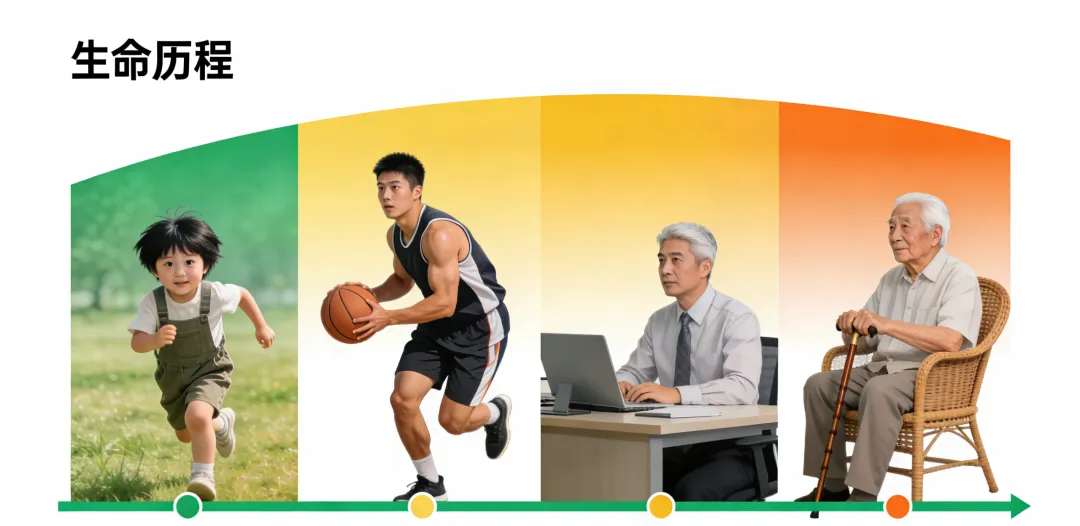
新概念四册学习笔记(第37课)
新概念四册学习笔记(第37课)
Lesson 37 The process of ageing
课文:
1. At the age of twelve years, the human body is at its most vigorous.
- 核心结构:主语 (the human body) + 系动词 (is) + 表语 (at its most vigorous)
- 语法要点:① At the age of twelve years 为介词短语作时间状语;② at its most vigorous 为固定表达,表 “处于最旺盛的状态”。
2. It has yet to reach its full size and strength, and its owner his or her full intelligence: but at this age the likelihood of death is least.
- 核心结构:分句 1 (It has yet to reach...) + 分句 2 (its owner his or her full intelligence,省略 has yet to reach) + 转折分句 (the likelihood...is least)
- 语法要点:① has yet to do 表 “尚未做某事”;② 第二个分句为省略结构,避免重复;③ the likelihood of death 为名词短语作主语。
- 释义:虽然这个时期人的身材、体力和智力还有待发展和完善,但是在这个年龄死亡的可能性最小。
3. Earlier, we were infants and young children, and consequently more vulnerable;
- 核心结构:主语 (we) + 系动词 (were) + 表语 1 (infants and young children) + 表语 2 (more vulnerable)
- 语法要点:① Earlier 为副词作时间状语;② consequently 为副词作状语,表 “因此”。
- 释义:再早一些,我们是幼儿和小孩子,身体比较脆弱。
4. Later, we shall undergo a progressive loss of our vigour and resistance which, though imperceptible at first, will finally become so steep that we can live no longer, however well we look after ourselves, and however well society, and our doctors, look after us.
- 句子类型:复合句(定语从句 + 结果状语从句 + 让步状语从句)
- 核心结构:主句 (we shall undergo...) + 定语从句 (which...will finally become...) + 结果状语从句 (so steep that...) + 让步状语从句 (however well...)
- 语法要点:① which 引导定语从句修饰 loss;② though imperceptible at first 为省略结构;③ so...that... 引导结果状语;④ however 引导让步状语从句。
- 释义:再迟一些,我们就要经历生命力和抵抗力逐渐衰退的过程。虽然这个过程起初难以察觉,但最终会急转直下,不管我们怎样精心照料自己,不管社会和医生怎样悉心照顾,我们也无法再活下去了。
5. This decline in vigour with the passing of time is called ageing.
- 核心结构:主语 (This decline) + 被动谓语 (is called) + 宾语 (ageing)
- 语法要点:① in vigour /with the passing of time 均为介词短语作后置定语;② 被动语态表 “被称作”。
6. It is one of the most unpleasant discoveries which we all make that we must decline in this way, that if we escape wars, accidents and diseases we shall eventually 'die of old age', and that this happens at a rate which differs little from person to person, so that there are heavy odds in favour of our dying between the ages of 65 and 80.
- 句子类型:复合句(定语从句 + 同位语从句 + 结果状语从句)
- 核心结构:主句 (It is...discoveries) + 定语从句 (which we all make) + 三个并列同位语从句 (that...) + 结果状语从句 (so that...)
- 语法要点:① It 为形式主语,真正主语是三个 that 同位语从句;② which differs little... 为定语从句修饰 rate;③ so that 引导结果状语。
- 释义:人类发现的最不愉快的一个事实是:人必然会衰老,即使我们能避开战争、意外和各种疾病,最终也会 “老死”,且衰老速度人与人相差甚微,因此我们极有可能在 65 至 80 岁之间离世。
7. Some of us will die sooner, a few will live longer--on into a ninth or tenth decade.
- 核心结构:分句 1 (Some of us will die sooner) + 分句 2 (a few will live longer)
- 语法要点:① a ninth or tenth decade 表 “八九十岁”;② 破折号表补充说明。
- 释义:有些人会死得早一些,少数人寿命会长一些 —— 活到八十几岁或九十几岁。
8. But the chances are against it, and there is a virtual limit on how long we can hope to remain alive, however lucky and robust we are.
- 核心结构:分句 1 (the chances are against it) + 分句 2 (there is a virtual limit...) + 让步状语从句 (however...)
- 语法要点:① the chances are against it 固定表达,表 “可能性很小”;② how long 引导宾语从句;③ however 引导让步状语。
- 释义:但这种可能性很小,不管我们多么幸运、多么健壮,我们所能期望的寿命实际上是有限度的。
9. Normal people tend to forget this process unless and until they are reminded of it.
- 核心结构:主句 (Normal people tend to forget...) + 状语从句 (unless and until...)
- 语法要点:① tend to do 表 “往往会做某事”;② unless and until 为固定搭配,表 “直到…… 才”。
- 释义:衰老的过程,不经提起,正常人容易忘记;一经提起,才会记起。
10. We are so familiar with the fact that man ages, that people have for years assumed that the process of losing vigour with time, of becoming more likely to die the older we get, was something self-evident like the cooling of a hot kettle or the wearing-out of a pair of shoes.
- 核心结构:主句 (We are so familiar with...) + 同位语从句 (that man ages) + 结果状语从句 (that people have...assumed...) + 宾语从句 (that the process...was...)
- 语法要点:① so...that... 引导结果状语;② that man ages 为同位语从句修饰 fact;③ the older we get 为比较状语从句。
- 释义:我们对人总会衰老的现象并不陌生,多年来人们一直认为,生命力随时间流失而减弱、年纪越大越接近死亡是不言而喻的,就像热水会变凉、鞋子会磨破一样。
11. They have also assumed that all animals, and probably other organisms such as trees, or even the universe itself, must in the nature of things 'wear out'.
- 核心结构:主句 (They have also assumed) + 宾语从句 (that all animals...must 'wear out')
- 语法要点:① that 引导宾语从句;② in the nature of things 固定短语,表 “本质上”。
- 释义:人们还认为,所有动物,或许还有树木等其他生物,甚至宇宙本身,本质上都会 “磨损殆尽”。
12. Most animals we commonly observe do in fact age as we do, if given the chance to live long enough;
- 句子类型:复合句(定语从句 + 方式状语从句 + 条件状语从句)
- 核心结构:主句 (Most animals...do in fact age) + 定语从句 (we commonly observe) + 方式状语从句 (as we do) + 条件状语从句 (if given...)
- 语法要点:① we commonly observe 为省略 that 的定语从句;② if given 为省略结构,完整为 if they are given。
- 释义:我们通常看到的大多数动物,只要能活得足够久,确实也会像我们一样衰老。
13. And mechanical systems like a wound watch, or the sun, do in fact run out of energy in accordance with the second law of thermodynamics (whether the whole universe does so is a moot point at present).
- 核心结构:主句 (mechanical systems...run out of energy) + 主语从句 (whether...)
- 语法要点:① in accordance with 固定短语,表 “遵循”;② 括号内为主语从句作插入语。
- 释义:像上发条的手表、太阳这样的机械系统,确实会遵循热力学第二定律耗尽能量(整个宇宙是否如此,目前尚无定论)。
14. But these are not analogous to what happens when man ages.
- 核心结构:主句 (these are not analogous to) + 宾语从句 (what happens) + 时间状语从句 (when man ages)
- 语法要点:① be analogous to 固定搭配,表 “与…… 相似”;② what 引导宾语从句。
15. A run-down watch is still a watch and can be rewound.
- 核心结构:主语 (A run-down watch) + 谓语 1 (is still a watch) + 谓语 2 (can be rewound)
- 语法要点:① run-down 为形容词作定语,表 “停走的、耗尽能量的”;② 被动语态 can be rewound。
16. An old watch, by contrast, becomes so worn and unreliable that it eventually is not worth mending.
- 语法要点:① by contrast 固定短语,表 “相比之下”;② so...that... 引导结果状语;③ be worth doing 表 “值得做某事”。
- 释义:相比之下,老旧手表磨损严重、走时不准,最终根本不值得修理。
17. But a watch could never repair itself--it does not consist of living parts, only of metal, which wears away by friction.
- 核心结构:主句 (a watch could never repair itself) + 补充句 (it does not consist...) + 定语从句 (which...)
- 语法要点:① consist of 固定搭配,表 “由…… 组成”;② which 引导定语从句修饰 metal。
- 释义:但手表永远无法自我修复 —— 它没有生命部件,只有金属,会因摩擦逐渐磨损。
18. We could, at one time, repair ourselves--well enough, at least, to overcome all but the most instantly fatal illnesses and accidents.
- 核心结构:主语 (We) + 谓语 (could repair) + 宾语 (ourselves)
- 语法要点:① at one time 表 “曾经、一度”;② all but 表 “除了…… 之外所有”。
- 释义:我们人类一度可以自我修复 —— 至少足以抵御除突发致命疾病与意外之外的一切问题。
19. Between twelve and eighty years we gradually lose this power; an illness which at 12 would knock us over, at 80 can knock us out, and into our grave.
- 核心结构:分句 1 (we gradually lose this power) + 分句 2 (an illness...can knock us out)
- 语法要点:① which 引导定语从句修饰 illness;② knock us over 表 “使病倒”;knock us out 表 “使丧命”。
- 释义:从 12 岁到 80 岁,我们逐渐丧失这种能力。12 岁时只会让我们病倒的疾病,到 80 岁可能会直接夺走我们的生命。
20. If we could stay as vigorous as we are at twelve, it would take about 700 years for half of us to die, and another 700 for the survivors to be reduced by half again.
- 核心结构:条件状语从句 (If we could stay...) + 主句 (it would take...)
- 语法要点:① 虚拟语气,与现在事实相反;② as...as... 原级比较;③ it takes some time for sb to do 固定句型。
- 释义:假如我们能保持 12 岁时的旺盛生命力,那么我们中有一半人会在 700 年后去世,剩下的人再活 700 年才会再减少一半。
一、核心名词
- ageing
- 搭配:the process of ageing 衰老过程
- 拓展:age v. 变老;aged adj. …… 岁的
- decline
- 搭配:a decline in vigour 活力衰退;economic decline 经济衰退
- likelihood
- 搭配:the likelihood of death 死亡可能性
- organism
- friction
- 搭配:wear away by friction 因摩擦磨损
- limit
- universe
二、核心形容词
- vigorous
- 搭配:at its most vigorous 最旺盛
- vulnerable /ˈvʌlnərəbl/adj. 脆弱的,易受伤的
- 搭配:be vulnerable to 易受…… 侵害
- progressive
- imperceptible /ˌɪmpəˈseptəbl/adj. 难以察觉的
- 搭配:imperceptible at first 起初难以察觉
- robust
- analogous
- 搭配:be analogous to 与…… 相似
- fatal
三、核心动词
- undergo /ˌʌndəˈɡəʊ/v. 经历,遭受(过去式 underwent,过去分词 undergone)
- decline
- repair
- wear
- 搭配:wear out 磨损;wear away 逐渐磨损
- reduce
四、重点短语
- at the age of
- 例句:At the age of twelve, the body is most vigorous.
- have yet to do
- 例句:It has yet to reach its full strength.
- die of old age
- differ little from person to person
- heavy odds in favour of
- 例句:There are heavy odds in favour of our dying between 65 and 80.
- tend to do
- unless and until
- be familiar with
- wear out
- in accordance with
- 例句:run out of energy in accordance with the law 遵循定律消耗能量
- be analogous to
- consist of
- knock over
- knock out
- reduce by half
- with the passing of time
五、必背同义替换(写作加分)
- vigour
- decline
- likelihood
- vulnerable
- undergo → experience / go through
- 1、主系表 + 后置定语(用于给事物 / 现象下定义)原句:This decline in vigour with the passing of time is called ageing.套用结构:This + 抽象名词 + in + 范畴名词 + with the passing of time is called + 核心概念名词.
- 适配场景:健康、环保、社会类作文,对现象进行专业定义
- 2、形式主语 + 同位语从句(用于引出公认事实 / 核心观点)原句:It is one of the most unpleasant discoveries which we all make that we must decline in this way.
- 套用结构:It is one of the most + 情感形容词 + discoveries which we all make that + 完整事实句子.
- 适配场景:议论文开头 / 主体段,强调普遍真理与现实
- 3、however 引导让步状语从句(用于强调客观规律不可抗拒)原句:however well we look after ourselves, we can live no longer.
- 套用结构:However + 副词 + 主语 + 谓语, 主语 + 谓语(表无奈结果).
- 4、主谓结构 + unless and until 条件状语(用于提醒忽视的问题)原句:Normal people tend to forget this process unless and until they are reminded of it.
- 套用结构:Normal people tend to + 动词原形 + 核心名词 + unless and until they are + 过去分词.
- 5、虚拟语气 + it takes 固定句型(用于假设与对比)原句:If we could stay as vigorous as we are at twelve, it would take about 700 years for half of us to die.
- 套用结构:If we could + 动词原形 + as + 形容词 + as + 参照对象, it would take + 时间 + for sb to do.
本文来自网友投稿或网络内容,如有侵犯您的权益请联系我们删除,联系邮箱:wyl860211@qq.com 。