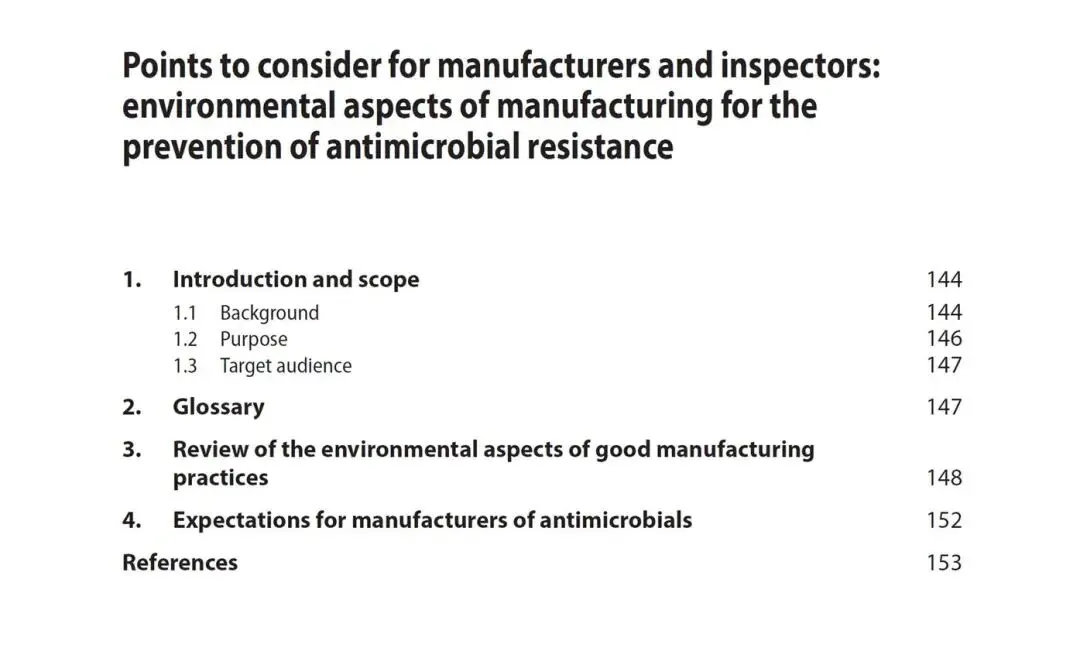
1.Introduction and scope
1.1 Background
According to research by UN Environment (1), growing antimicrobial resistance (AMR) linked to the discharge of drugs and particular chemicals into the environment is one of the most worrying health threats of today. AMR accounts for an estimated 700 000 deaths per year worldwide and, by 2030, will represent up to US$ 3.4 trillion in gross domestic product (GDP) loss (2). AMR has been identified as a priority at the World Health Assembly since 1998 (3), with rising momentum throughout the years. Since 1998, there have been a series of World Health Assembly resolutions on AMR. These paved the way to the Sixtyeighth World Health Assembly in May 2015, where the World Health Assembly endorsed a global action plan to tackle AMR, including antibiotic resistance, the most urgent drug resistance trend (4). More recently, the Thirteenth General Programme of Work (2019–2023) highlighted the need to address this emerging threat, under the section for “Tackling antimicrobial resistance” (2). It is only recently that the need to address waste and wastewater management from pharmaceutical production has been explicitly addressed. Namely, on 30 November 2018, the World Health Organization’s (WHO’s) Executive Board meeting decided that technical input will be provided to good manufacturing practices (GMP) guidance on waste and wastewater management from the production of critically important antimicrobials (5, 6). The present Points to consider document was written further to this recent decision.
1. 引言与范围
1.1 背景
根据联合国环境规划署(UN Environment)的研究(1),与药物及特定化学品向环境排放相关的抗菌药物耐药性(AMR)日益加剧,是当今最令人担忧的健康威胁之一。全球每年约有 70 万人死于抗菌药物耐药性,到 2030 年,其造成的国内生产总值(GDP)损失将高达 3.4 万亿美元(2)。自 1998 年以来,抗菌药物耐药性一直是世界卫生大会的重点关注议题(3),多年来关注度持续提升。1998 年以来,世界卫生大会通过了一系列关于抗菌药物耐药性的决议,为 2015 年 5 月第六十八届世界卫生大会奠定了基础。该届大会通过了一项应对抗菌药物耐药性的全球行动计划,其中包括最紧迫的耐药趋势 —— 抗生素耐药性(4)。最近,《第十三个工作总规划(2019-2023 年)》在 “应对抗菌药物耐药性” 部分强调了应对这一新兴威胁的必要性(2)。直到最近,制药生产产生的废物和废水管理问题才得到明确关注。具体而言,2018 年 11 月 30 日,世界卫生组织(WHO)执行委员会会议决定,将为关键重要抗菌药物生产过程中的废物和废水管理相关GMP指南提供技术投入(5, 6)。本《应考虑的要点》文件正是基于这一近期决定编写的。
We are entering a post-antibiotic era, where simple and previously treatable bacterial infections can kill and where routine medical procedures that rely on antibiotic preventative treatment, such as joint replacements and chemotherapy, will not be possible. The 2014 O’Neill report commissioned by the Government of the United Kingdom of Great Britain and Northern Ireland estimated that antimicrobial-resistant infections may become the leading cause of death globally by 2050 (7).
我们正步入后抗生素时代,在这个时代,简单且以往可治疗的细菌感染可能致命,而依赖抗生素预防治疗的常规医疗操作(如关节置换术和化疗)将无法开展。2014 年,受大不列颠及北爱尔兰联合王国政府委托编写的《奥尼尔报告》估计,到 2050年,抗菌药物耐药性感染可能成为全球首要死因(7)。
The environment plays an important role in antimicrobial resistance. Microorganisms in soil, rivers and seawater can develop resistance through contact with resistant microbes (transfer of resistance genes), antibiotics and disinfectant agents released by human activity (1), as well as heavy metals (8, 9) that may propagate AMR in the environment. People and livestock could then be exposed to more resistant bacteria through food, water and air (1).
环境在抗菌药物耐药性的产生和传播中起着重要作用。土壤、河流和海水中的微生物可通过接触人类活动释放的耐药微生物(耐药基因转移)、抗生素和消毒剂(1),以及可能在环境中促进抗菌药物耐药性扩散的重金属(8, 9)而产生耐药性。随后,人类和牲畜可能通过食物、水和空气接触到耐药性更强的细菌(1)。
Pharmaceuticals entering the environment from industrial manufacturing activities are not the major source of antimicrobial resistance, but in countries that contribute the most to the production of antimicrobials, this issue can be significant. The levels of pollution with antimicrobials have been measured in waters in the proximity of pharmaceutical production facilities. Antimicrobial concentrations in some effluents are too low to be lethal to exposed bacteria but may still be sufficient to induce antimicrobial resistance (1, 10), but high concentrations have been found downstream of antimicrobial manufacturing sites in several countries. Scientific literature reports a correlation between the type and number of highly resistant bacteria and the level of antimicrobial pollution (10). This led to manufacturing sites being identified as one of the hot spots for development of AMR, but this knowledge dates from only a few years ago (11).
工业生产活动中进入环境的药物并非抗菌药物耐药性的主要来源,但在抗菌药物生产贡献最大的国家,这一问题可能十分突出。已有研究对制药生产设施周边水体中的抗菌药物污染水平进行了检测。部分废水中的抗菌药物浓度虽不足以对接触到的细菌造成致命影响,但仍可能足以诱导抗菌药物耐药性(1, 10),而在多个国家的抗菌药物生产场地下游,已检测到高浓度的抗菌药物。科学文献表明,高耐药性细菌的种类和数量与抗菌药物污染水平存在相关性(10)。这使得生产场地被认定为抗菌药物耐药性产生的热点区域之一,但这一认知仅形成于近几年(11)。
Poor control of waste (solid1 or liquid) and wastewater, such as that encountered in some of the countries that are major global producers of pharmaceuticals, can often lead to the entry of antimicrobials into waters that are contaminated with pathogenic bacteria from untreated sewage. This increases the risk of development of AMR. Furthermore, a vast array of contaminants in municipal and industrial wastewater increases pressure on bacteria to become resistant (1, 11). Eventually, from the passage of the production cycle to the effluent pipe, antimicrobial molecules (precursors and by-products) turn from valuable medicine to hazardous waste that has an impact on the efficacy of the product as well as human health and the environment.
在一些全球主要制药生产国,废物(固体1或液体)和废水的控制措施不完善,这往往导致抗菌药物进入已被未经处理的污水中的致病菌污染的水体,从而增加抗菌药物耐药性产生的风险。此外,城市和工业废水中含有的大量污染物会加剧细菌产生耐药性的压力(1, 11)。最终,从生产周期到废水排放,抗菌药物分子(前体和副产物)从有价值的药物转变为有害废物,既影响产品疗效,也对人类健康和环境造成危害。
注 1:本文件也涉及固体废物,因为若处置不当,各类固体废物可能渗入周边环境并污染废水。
Concentrations in river water depend on wastewater treatment facilities, as well as antimicrobial use in the populations they serve. Treatment plants are generally designed to remove conventional pollutants such as nutrients, organic matter, suspended solids and pathogens, but not pharmaceuticals such as antimicrobial agents (1). The level of treatment of manufacturing effluents or pharmaceutical waste (solid or liquid) can vary significantly, resulting in the necessity for municipal wastewater treatment plants to handle the waste. However, the activated waste may up-concentrate some antimicrobial agents, as well as antimicrobial-resistant bacteria, increasing the risk for AMR in environments where the sludge is applied. Recent evidence indicates the presence of a selection pressure for AMR within environments receiving wastewater from antimicrobial manufacturing, as opposed to environments receiving wastewater from municipal sewage treatment plants (12) that do not receive waste from antimicrobial manufacturing.
河水中的抗菌药物浓度取决于污水处理设施的处理效果以及所服务人群的抗菌药物使用情况。污水处理厂的设计初衷通常是去除营养物质、有机物、悬浮固体和病原体等常规污染物,而非抗菌药物等药物(1)。制药企业废水或制药废物(固体或液体)的处理水平差异较大,导致城市污水处理厂必须处理这类废物。然而,活性污泥可能会浓缩某些抗菌药物以及耐药细菌,增加污泥施用环境中抗菌药物耐药性产生的风险。近期有证据表明,与接收不含抗菌药物生产废物的城市污水处理厂废水的环境相比,接收抗菌药物生产废水的环境中存在抗菌药物耐药性的选择压力(12)。
It is therefore important to significantly reduce the concentration of antimicrobials prior to disposal into the environment. However, the recommended approach in the absence of established standards would be to apply the precautionary principle, i.e. to not emit any waste until there is proof that the discharge does not have an adverse effect on human health or the environment.
因此,在将废水排放到环境之前,大幅降低其中的抗菌药物浓度至关重要。然而,在缺乏既定标准的情况下,建议采用预防原则,即在证明排放不会对人类健康或环境产生不利影响之前,不排放任何废物。
Several initiatives have already been put in place by the United Nations (13, 14), WHO (4), nongovernmental institutions (15–17), governments (18–24) and the industry itself (25–29). Industry should be committed to caring for the environment, and responsible manufacturing is encouraged by taking steps to minimize the environmental impact of operations and products, while also balancing the need to produce high-quality, life-saving medication.
联合国(13, 14)、世界卫生组织(4)、非政府机构(15-17)、各国政府(18-24)以及制药行业自身(25-29)已采取多项举措。制药行业应致力于环境保护,鼓励开展负责任的生产,采取措施最大限度减少生产运营和产品对环境的影响,同时平衡高质量救命药物的生产需求。
This document is to be considered as a time-limited document that addresses the current needs for guidance on how GMP should be implemented to waste and wastewater management for production of antimicrobials. It leverages on the existing GMP and makes reference to relevant literature rather than containing detailed instructions. This document may be updated in the future, as the knowledge about suitable technologies on how to remove antimicrobial residues is expected to increase within the next few years and the requirements may be modified/adapted in consequence.
本文件为时效性文件,旨在满足当前抗菌药物生产过程中废物和废水管理相关GMP实施指导的需求。文件以cGMP为基础,参考相关文献,不包含详细操作说明。未来几年,关于去除抗菌药物残留的适宜技术的知识预计将不断增加,相关要求可能因此进行修订或调整,因此本文件可能会随之更新。
1.2 Purpose
The purpose of this document is to:
provide recommendations and expectations for manufacturing
facilities for medicines regarding waste management, to mitigate/ prevent potential antimicrobial resistance;
raise awareness of medicines’ manufacturers, national regulatory authorities (NRAs) and especially GMP inspectorates and inspectors in all Member States, on sections of relevant GMP guidance that are applicable to the management of waste/wastewater from the production of antimicrobials, while emphasizing the importance
of all aspects of GMP implementation and considering the parts of GMP that may not have a direct impact on product quality; and provide clarification on the interpretation of those clauses and specific measures that should be taken to be considered compliant with the relevant sections of GMP guidance, without changing the scope of GMP.
1.2 目的
本文件目的:
为制药生产设施提供废物管理相关建议和要求,以减轻或预防潜在的抗菌药物耐药性;
提高所有成员国的制药企业、国家监管机构(NRA),尤其是GMP检查机构和检查员,对与抗菌药物生产废物 / 废水管理相关的GMP指南条款的认识,同时强调全面实施GMP的重要性,并考虑到GMP中可能对产品质量无直接影响的部分;
在不改变GMP范围的前提下,澄清对这些条款的解读,以及为符合GMP指南相关部分要求应采取的具体措施。
This document is not intended to cover AMR issues that are related to the human or veterinary use of antimicrobials or to other types of environmental contamination (1), such as the excretion of antimicrobials during their use. It should not be considered to provide exhaustive information on methods that can be used to control and reduce contamination of the environment with antimicrobials and related chemicals, such as active precursors or by-products coming from pharmaceutical production processes. It should also not be considered to provide information on the levels of antimicrobial residues that are considered acceptable.
本文件不涉及与人类或兽医使用抗菌药物相关的抗菌药物耐药性问题,也不涉及其他类型的环境污染(1),例如使用过程中抗菌药物的排泄。本文件不提供控制和减少抗菌药物及相关化学品(如制药生产过程中产生的活性前体或副产物)环境污染的详尽方法信息,也不规定可接受的抗菌药物残留水平。
1.3 Target audience
This document is targeted to:
all pharmaceutical manufacturers engaging in synthesis and/ or production of antimicrobials (primarily manufacturing sites for active pharmaceutical ingredients [APIs] and, secondly, manufacturing sites for finished pharmaceutical products [FPPs]); GMP inspectors and inspectorates from national medicines regulatory authorities;
regulatory bodies that are responsible for enforcing environmental protection standards and waste/wastewater management in all Member States – consistent with a multidisciplinary approach, including but not limited to ministries of health, ministries of environment or pollution control boards, and ministries of agriculture, as appropriate; and
waste and wastewater management services that handle antimicrobial waste and/or process effluents from the pharmaceutical industry.
1.3 目标受众
本文目标受众包括:
- 所有从事抗菌药物合成和 / 或生产的制药企业(主要是原料药(API)生产场地,其次是制剂(FPP)生产场地);
- 所有成员国中负责执行环境保护标准和废物/ 废水管理的监管机构 —— 采用多学科协作方式,酌情包括但不限于卫生部、环境部或污染控制委员会以及农业部;
- 处理抗菌药物废物和 / 或制药行业工艺废水的废物和废水管理服务机构。
2.Glossary
The definitions given below apply to the terms as used in this guideline that are not defined in existing WHO terms and definitions databases. They may have different meanings in other contexts.
2. 术语表
以下定义适用于本指南中使用的、未在世界卫生组织现有术语和定义数据库中定义的术语。这些术语在其他语境中可能有不同含义。
active pharmaceutical ingredient (API). Any substance or mixture of substances intended to be used in the manufacture of a pharmaceutical dosage form and that, when so used, becomes an active ingredient of that pharmaceutical dosage form. Such substances are intended to furnish pharmacological activity or other direct effect in the diagnosis, cure, mitigation, treatment or prevention of disease, or to affect the structure and function of the body.
原料药(API):指旨在用于制药剂型生产的任何物质或物质混合物,当用于该用途时,成为该制药剂型的活性成分。此类物质旨在在疾病的诊断、治愈、减轻、治疗或预防中提供药理活性或其他直接作用,或影响人体的结构和功能。
antimicrobial resistance (AMR). Antibiotic resistance develops when bacteria adapt and grow in the presence of antibiotics. The development of resistance is linked to how often antibiotics are used. Because many antibiotics belong to the same class of medicines, resistance to one specific antibiotic agent can lead to resistance to a whole related class. Resistance that develops in one organism or location can also spread rapidly and unpredictably through, for instance, the exchange of genetic material between different bacteria, and can affect antibiotic treatment of a wide range of infections and diseases. Drug-resistant bacteria can circulate in populations of human beings and animals, through food, water and the environment, and transmission is influenced by trade, travel and both human and animal migration. Resistant bacteria can be found in food, animals
and food products destined for consumption by humans. Some of these features also apply to medicines that are used to treat viral, parasitic and fungal diseases, hence the broader term antimicrobial resistance.
抗菌药物耐药性(AMR):指细菌在抗生素存在的环境中适应并生长,从而产生对抗生素的耐药性。耐药性的产生与抗生素的使用频率相关。由于许多抗生素属于同一类药物,对某一种特定抗生素的耐药性可能导致对整类相关药物的耐药性。在某一生物体或某一地点产生的耐药性还可通过不同细菌间的基因物质交换等方式快速且不可预测地传播,并可能影响多种感染和疾病的抗生素治疗效果。耐药细菌可通过食物、水和环境在人类和动物群体中传播,贸易、旅行以及人类和动物的迁徙都会影响其传播。在食物、动物以及供人类食用的食品中均可能发现耐药细菌。这些特征中的部分也适用于治疗病毒、寄生虫和真菌疾病的药物,因此使用更宽泛的术语 “抗菌药物耐药性”。
finished pharmaceutical product (FPP). A finished dosage form of a pharmaceutical product that has undergone all stages of manufacture, including packaging in its final container and labelling.
制剂(FPP):指经过所有生产阶段(包括在最终容器中包装和贴签)的制药产品的最终剂型。
3.Review of the environmental aspects of good manufacturing practices
GMP are, a priori, intended to control the manufacture of medicines, and in principle do not focus on the environmental aspects of these. However, GMP include many aspects related to the protection of the environment and workers. If fully implemented, GMP should therefore prevent many different types of waste from contaminating the environment.
3.GMP中的环境相关方面回顾
GMP本质上旨在控制药品生产,原则上不侧重于生产的环境相关方面。然而,GMP包含许多与环境保护和工人保护相关的内容。因此,若得到全面实施,GMP应能防止多种类型的废物污染环境。
Given that the lack of control in the downstream processes of manufacturing medicines will ultimately lead to their loss in efficacy, we may no longer focus only on the aspects of GMP that are directly linked to the quality of medicines. Medicines that are no longer effective lose their value and it is therefore crucial for manufacturers and all stakeholders to take action in order to protect the efficacy of those medicines. Only one major class of antibiotics has been discovered since 1987 (30) and too few antibacterial agents are in development to meet the challenge of multidrug resistance (4).
鉴于制药生产下游过程缺乏控制最终会导致药物失效,我们不应再仅关注GMP中与药品质量直接相关的方面。失效的药物将失去其价值,因此制药企业及所有利益相关方采取行动保护这些药物的疗效至关重要。自 1987 年以来,仅发现了一类主要的新抗生素(30),而正在研发的抗菌药物数量过少,难以应对多重耐药性的挑战(4)。
The WHO good manufacturing practices for pharmaceutical products: main principles (31) and WHO good manufacturing principles for active pharmaceutical ingredients (32) contain a limited set of clauses related to environmental issues. Waste and wastewater management are addressed only briefly. The following clauses are the only ones considered to be of relevance:
《世界卫生组织药品GMP:主要原则》(31)和《世界卫生组织原料药GMP》(32)包含少量与环境问题相关的条款,仅简要涉及废物和废水管理。以下是仅有的相关条款:
WHO good manufacturing practices for pharmaceutical products: main principles. Annex 2, WHO Technical Report Series, No. 986, 2014 (31)
Waste materials
14.44 Provisions should be made for the proper and safe storage of waste materials awaiting disposal. Toxic substances and flammable materials should be stored in suitably designed, separate, enclosed cupboards, as required by national legislation.
14.45 Waste material should not be allowed to accumulate. It should be collected in suitable receptacles for removal to collection points outside the buildings and disposed of safely and in a sanitary manner at regular and frequent intervals.
《世界卫生组织药品GMP:主要原则》,附件 2,《世界卫生组织技术报告系列》第 986 号,2014 年(31)
废物
14.44 应为待处置废物的妥善和安全储存作出规定。有毒物质和易燃物质应按照国家法规要求,储存在设计适当、独立的密闭柜中。
14.45 不应允许废物堆积。废物应收集在适当的容器中,转移至建筑物外的收集点,并定期、频繁地以安全、卫生的方式处置。
WHO good manufacturing practices for active pharmaceutical ingredients. Annex 2, WHO Technical Report Series, No. 957, 2010 (32)
4.6 Sewage and refuse
4.60 Sewage, refuse and other waste (e.g. solids, liquids or gaseous by-products from manufacturing) in and from buildings and the immediate surrounding area should be disposed of in a safe, timely and sanitary manner. Containers and/or pipes for waste material should be clearly identified.
《世界卫生组织原料药GMP》,附件 2,《世界卫生组织技术报告系列》第 957 号,2010 年(32)
4.6 污水和垃圾
4.60 建筑物内及其紧邻区域的污水、垃圾和其他废物(如生产产生的固体、液体或气体副产物)应按照安全、及时且卫生的方式处置。废物容器和 / 或管道应清晰标识。
On the other hand, the WHO good manufacturing practices for pharmaceutical products containing hazardous substances (33) contains more detailed requirements regarding waste and wastewater management, which can be applied to the production of antimicrobials. These guidelines cover those hazardous substances traditionally belonging to reproductive health hormones and highly potent materials such as steroids or sensitizing medicines such as beta-lactam antibiotics. According to these guidelines, a hazardous substance or product is a “product or substance that may present a substantial risk of injury, to health or to the environment”. As antimicrobials are deemed to present a substantial risk of injury to both health and the environment, when released into the environment through their action on microorganisms, they should be considered for inclusion in the scope of this guidance.
另一方面,《世界卫生组织含危险物质药品GMP》(33)包含更详细的废物和废水管理要求,这些要求可适用于抗菌药物生产。该指南涵盖传统上属于生殖健康激素的危险物质、类固醇等高活性物质,以及 β- 内酰胺类抗生素等致敏药物。根据该指南,危险物质或产品是指 “可能对健康或环境造成重大伤害风险的产品或物质”。由于抗菌药物释放到环境中后,通过其对微生物的作用,被认为会对健康和环境均造成重大伤害风险,因此应将其纳入本指南的适用范围。
The following clause is considered to be of general relevance to the protection of the operators, the environment and the public:
WHO good manufacturing practices for pharmaceutical products containing hazardous substances. Annex 3, WHO Technical Report Series, No. 957, 2010 (33)
General
2.1 Facilities should be designed and operated in accordance with the main GMP principles, as follows:
–– to ensure quality of product;
–– to protect the operators from possible harmful effects of products containing hazardous substances; and
–– to protect the environment from contamination and thereby protect the public from possible harmful effects of products containing hazardous substances.
以下条款被认为与操作人员、环境和公众保护具有普遍相关性:
《世界卫生组织含危险物质药品GMP》,附件 3,《世界卫生组织技术报告系列》第 957 号,2010 年(33)
总则
2.1 设施的设计和运营应遵循以下主要GMP原则:
—— 确保产品质量;
—— 保护操作人员免受含危险物质产品可能带来的有害影响;
—— 保护环境免受污染,进而保护公众免受含危险物质产品可能带来的有害影响。
The guidelines require risk assessments to determine the potential hazards to the operators and to the environment of hazardous substances contained in all types of waste, as per the following clauses:
Risk assessment
4.1 Not all products containing hazardous substances are equally potent and risk assessments should be carried out to determine the potential hazards to operators and to the environment. The risk assessment should also determine which phases of the product production and control cycles, from manufacture of the API to distribution of the finished product, would fall under the requirements of these guidelines. Risk assessments applicable to the environment should include airborne contamination as well as liquid effluent contamination.
4.2 Assuming that the risk assessment determines that the products or materials being handled pose a risk to the operators and/or the public and/or the environment, the guidelines to be followed for the design and operation of the facility should be as detailed in this document.
该指南要求进行风险评估,以确定各类废物中含有的危险物质对操作人员和环境的潜在危害,相关条款如下:
风险评估
4.1 并非所有含危险物质的产品都具有同等毒性,应进行风险评估以确定对操作人员和环境的潜在危害。风险评估还应确定产品生产和控制周期的哪些阶段(从原料药生产到制剂产品分销)应遵守本指南的要求。适用于环境的风险评估应包括空气传播污染和液体废水污染。
4.2 若风险评估确定所处理的产品或材料对操作人员和 / 或公众和 / 或环境构成风险,则设施的设计和运营应遵循本文件中详细规定的指南要求。
Such risk assessments should therefore be performed by manufacturers as required, in principle, for any substance deemed to be hazardous.
因此,原则上,对于任何被认定为危险的物质,制药企业应按要求进行此类风险评估。
The guidance already has a requirement prohibiting discharge of hazardous substances into normal drainage systems:
Environmental protection
7.1 Due to the hazardous nature of the products being handled in the facility, neither the product nor its residues should be allowed to escape into the atmosphere or to be discharged directly to normal drainage systems.
该指南已包含禁止向普通排水系统排放危险物质的要求:
环境保护
7.1 由于设施中处理的产品具有危险性,不得允许产品及其残留物泄漏到大气中或直接排放至普通排水系统。
It also has a requirement for protection of the atmosphere and the public in the local vicinity:
7.2 The external atmosphere and the public in the vicinity of the facility should be protected from possible harm from hazardous substances.
该指南还对保护大气和周边公众作出要求:
7.2 应保护设施周边的大气环境和公众免受危险物质可能带来的危害。
The above clause may be considered to apply to effluents and water streams near facilities, as their contamination with antimicrobials can have a public health impact. The literature contains several reports of effluents and water streams contaminated with potentially dangerous levels of antimicrobials (8, 10, 12).
上述条款可被视为适用于设施周边的废水和水体,因为其中的抗菌药物污染可能对公众健康产生影响。已有多项文献报道,部分废水和水体中的抗菌药物污染达到了具有潜在危险的水平(8, 10, 12)。
The guidance also has a requirement for treatment of hazardous effluent before it is discharged:
7.3 If liquid effluent poses a safety or contamination risk, the effluent should be treated before being discharged to a municipal drain.
该指南还要求在排放前对危险废水进行处理:
7.3 若液体废水存在安全或污染风险,应在排放至城市排水系统前进行处理。
However, it should be noted that the municipal drain may not be suitable to handle the large quantities of hazardous effluents such as those that are released by large pharmaceutical companies, and therefore manufacturers are requested to carefully consider this in their approach.
但需注意,城市排水系统可能不适合处理大量危险废水(如大型制药企业排放的废水),因此要求制药企业在制定处理方案时对此予以审慎考虑。
The guidance also contains a general statement about handling of liquid and solid waste effluent and another about safe disposal:
13. Effluent treatment
13.1 Liquid and solid waste effluent should be handled in such a manner as not to present a risk of contamination to the product, personnel or to the environment.
13.2 All effluent should be disposed of in a safe manner, and the means of disposal should be documented. Where external contractors are used for effluent disposal they should have certification authorizing them to handle and treat hazardous products.
该指南还包含关于液体和固体废物处理的一般规定以及关于安全处置的规定:
13. 废水处理
13.1 液体和固体废物的处理方式应避免对产品、人员或环境造成污染风险。
13.2 所有废水均应按照安全方式处置,处置方式应予以记录。若委托外部承包商进行废水处置,该承包商应具备处理和处置危险产品的相关资质认证。
As per the above clause, where external contractors are used for effluent disposal, they should have certification authorizing them to handle and treat hazardous products.
根据上述条款,若委托外部承包商进行废水处置,该承包商应具备处理和处置危险产品的相关资质认证。
The management of waste that is obtained from quality control testing in a laboratory setting at a manufacturer’s site or contract laboratory is covered by the following clause:
Guidance on good practices for pharmaceutical quality control laboratories. Annex 1, WHO Technical Report Series, No. 957, 2010 (34)
7. Premises
7.6 Procedures should be in place for the safe removal of types of waste including toxic waste (chemical and biological), reagents, samples, solvents and air filters.
制药企业内部实验室或合同实验室的质量控制测试产生的废物管理,适用以下条款:
《制药质量控制实验室良好规范指南》,附件 1,《世界卫生组织技术报告系列》第 957 号,2010 年(34)
7. 设施
7.6 应制定相关程序,以安全清除各类废物,包括有毒废物(化学和生物废物)、试剂、样品、溶剂和空气过滤器。
The amount of antimicrobial waste being generated by laboratory testing activities is generally considered to be negligible compared to the amounts that are being generated by manufacturing activities but should still be considered in exceptional cases, e.g. if very large amounts of sample are being tested by a quality control laboratory.
与生产活动产生的抗菌药物废物量相比,实验室测试活动产生的抗菌药物废物量通常被认为可忽略不计,但在特殊情况下(如质量控制实验室测试大量样品时)仍应予以考虑。
4.Expectations for manufacturers of antimicrobials
Application of the requirements outlined in the above-mentioned GMP clauses shall be verified during onsite inspections. In addition, manufacturers of APIs and FPPs should consider retaining documentation on the following:
a risk assessment for all contaminants related to antimicrobial manufacturing, in the event that they are released into the environment, and the associated risk of development of resistant microorganisms;
based on the above risk assessment, waste-stream analysis for each antimicrobial agent produced (at API sites and FPP sites). This analysis should be repeated whenever there is a change in production affecting waste streams;
the quantity and nature of the waste generated, including the analytical data and documentation of analyses performed and their findings on the levels of antimicrobial agents or their precursors;
regular reports on the collection, treatment and disposal of waste and wastewater; the frequency should be risk-based and in line with local, regional or international regulatory requirements, as applicable; information on the methods used to treat the waste should be documented to be effective for each specific antimicrobial or antimicrobial precursor. Analytical data demonstrating the conversion of these substances and their residues to non-hazardous waste materials should be available at the facility and kept up to date; if effective waste treatment is not yet implemented for all waste streams resulting from the manufacture of each API or FPP, documentation on a time-limited strategy should be in place, with specified milestones for that implementation, specifying actions towards achieving treatment that significantly reduces the concentration of the antimicrobial substance or its precursor (and its microbial source, when relevant); and
a rationale and risk assessment as to why the manufacturer selected specific methods of decontamination of manufacturing waste containing antimicrobials and/or their mitigation strategy. Many decontamination methods already exist that reduce or remove antimicrobials (and microbes that have produced fermentative antimicrobials) from waste streams entering the environment from antimicrobial manufacturing: secondary and tertiary wastewater treatment; membrane filtration and ozonation; and ultraviolet disinfection and heat treatment, which are even more effective at removing viable bacteria (1, 11). Incineration may also be considered for solid or semi-liquid waste. The zero-liquid effluent approach or zero-discharge policy is encouraged, especially when the risk is assessed to be high or unclear, as it prevents any contamination of the environment. The level of effectiveness and by-products should be considered when adopting a particular approach.
4.对抗菌药物制药企业的要求
上述GMP条款中概述的要求将在现场检查期间进行核实。此外,原料药(API)和制剂(FPP)制药企业应考虑保留以下相关文件:
- 所有与抗菌药物生产相关的污染物(若释放到环境中)的风险评估,以及相关耐药微生物产生的风险;
- 基于上述风险评估,对所生产的每种抗菌药物(在原料药生产场地和制剂生产场地)进行废物流分析。当生产发生影响废物流的变化时,应重新进行该分析;
- 产生废物的数量和性质,包括分析数据、已执行的分析记录及其关于抗菌药物或其前体水平的检测结果;
- 废物和废水收集、处理及处置的定期报告;报告频率应基于风险,并符合适用的地方、区域或国际监管要求;应记录所采用的废物处理方法对每种特定抗菌药物或其前体的有效性,设施内应备有能证明这些物质及其残留物转化为无害废物的分析数据,并保持更新;若尚未对每种原料药或制剂生产产生的所有废物流实施有效的废物处理,则应制定限时实施策略文件,明确实施里程碑,详细说明为实现大幅降低抗菌药物或其前体(以及相关微生物来源,如适用)浓度而采取的行动;
- 制药企业选择特定含抗菌药物生产废物净化方法和 / 或缓解策略的理由及风险评估。目前已有多种净化方法可从抗菌药物生产排放到环境的废物流中减少或去除抗菌药物(以及产生发酵型抗菌药物的微生物):二级和三级废水处理、膜过滤和臭氧氧化、紫外线消毒和热处理 —— 其中热处理在去除活菌方面效果更佳(1, 11)。固体废物或半固体废物可考虑采用焚烧处理。鼓励采用零液体排放方法或零排放政策,尤其是在风险评估结果为高风险或风险不明时,因为该方法可防止对环境造成任何污染。采用特定方法时,应考虑其有效性和副产物情况。
It is recommended that this documentation be maintained at the manufacturing facility regardless of whether or not an external contractor has been used. These points to consider should be used by manufacturers as part of their self-audits, in order to verify their continued level of GMP compliance. Although the aim is not to reduce verification of the quality of products, the waste management practices and related documentation listed in this Points to consider document could be reviewed and scrutinized during regulatory inspections.
建议无论是否委托外部承包商,均应在生产设施内留存上述文件。制药企业应将这些应考虑的要点作为自检的一部分,以核实其持续符合GMP的水平。尽管本文件的目的并非降低对产品质量的核查要求,但监管机构在检查过程中可对本《应考虑的要点》文件中列出的废物管理做法及相关文件进行审查和核查。
It should be noted that the above requirements will not be used to draw a conclusion on the level of GMP compliance of a manufacturing site. Their purpose is to guide/encourage manufacturers to apply all of the GMP principles. The application of these principles will help to tackle the emergence of AMR, by raising awareness of the preventative measures that manufacturers should take to adequately manage the waste and wastewaters that are generated while manufacturing antimicrobials.
需注意,上述要求不会用于判定生产场地的GMP合规水平。其目的是指导 / 鼓励制药企业全面应用GMP原则。通过提高制药企业对充分管理抗菌药物生产过程中产生的废物和废水所需采取的预防措施的认识,这些原则的应用将有助于应对抗菌药物耐药性的产生。
 10个月宝宝每天需要喝多少奶粉?

